
Community Advisory Panel on Neighbourhood Noise
Formed in 2022, the Community Advisory Panel on Neighbourhood Noise submitted six recommendations to MSO on managing neighbourhood noise, which MSO has since accepted and acted on through public education, stakeholder engagement, and legislative enhancements.
Last updated 8 June 2026
About the Community Advisory Panel on Neighbourhood Noise
Neighbourhood noise disturbance is not uncommon in a densely populated country like Singapore. However, the issue can be worsened by a lack of consideration or communication between neighbours. Such disturbances may disrupt daily activities such as work, study or rest, and negatively affect residents' quality of life.
Neighbourhood noise can be broken down into two main categories:
Noise from neighbours, which refers to noise from neighbouring units, such as from gatherings, furniture dragging and DIY renovation; and
Congregational noise, which refers to noise created by people gathering in residential common areas, such as void decks, playgrounds and exercise areas.
Then-Senior Minister of State for National Development, Ms Sim Ann, announced the formation of a Community Advisory Panel (CAP) on Neighbourhood Noise at the Ministry of National Development (MND) Committee of Supply Debate on 8 March 2022.
How the CAP Made a Difference
The CAP was convened to establish what are considered acceptable or unacceptable noise disturbances, and community norms that residents should adopt to manage noise disturbances.
The CAP submitted six recommendations to MSO to manage neighbourhood noise in November 2022. MSO subsequently worked with the CAP to follow up on its recommendations.
Recommendation Report
Please refer to the reports below (click on the images to find out more).
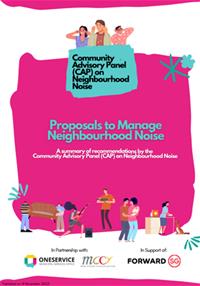
CAP's Recommendations
The CAP proposed the following community norms to manage neighbourhood noise, after extensive consultation with the public:
We should proactively build relationships with our neighbours from the onset, which would help us reach a mutual understanding in a friendly manner;
We should practise considerate behaviours within our community to create a peaceful and harmonious living environment; and
We should extend our quiet hours from the current 10.30 pm to 7.00 am, to 10.00 pm to 8.00 am. Residents should be considerate and observe the extended quiet hours.
The CAP also proposed a list of considerate behaviours as outlined in the table below:
Table 1. Proposed considerate behaviours
Type of Neighbourhood Noise | Proposed Considerate Behaviours |
|---|---|
Movement-Related |
|
Activity-Related |
|
Renovation-Related |
|
Pet-Related |
|
MSO’s Responses
Given the complexity of the issue, MSO engaged key stakeholders, including grassroots leaders, businesses, academics and public agencies in 2023 to review the CAP’s recommendations. A summary of MSO’s responses can be found below.
Table 2. MSO’s responses to the CAP’s recommendations on community norms to manage neighbourhood noise.
CAP’s Recommendations on Community Norms to Manage Neighbourhood Noise | MSO’s Responses |
|---|---|
Recommendation 1: We should proactively build relationships with our neighbours from the onset, which would help us reach a mutual understanding in a friendly manner. | MSO accepts the recommended norms, and has worked with the Singapore Kindness Movement (SKM), Ministry of Culture, Community and Youth (MCCY), Housing & Development Board (HDB), and Community Mediation Centre (CMC) since 2023 to incorporate these norms and considerate behaviours into our respective public education campaigns. MSO also highlighted these considerate behaviours at its Noise Experiential Lab conducted from September 2023 to January 2024, where visitors learned about the impact of neighbour noise through an immersive, hands-on experience. MSO will continue to work with community partners and agencies to promote these recommended norms and considerate behaviours to residents and general public on social media. |
Recommendation 2: We should practise considerate behaviours for our community to create a peaceful and harmonious living environment. | |
Recommendation 3: We should extend our quiet hours from the current 10.30 pm to 7.00 am, to 10.00 pm to 8.00 am. Residents should be considerate and observe the extended quiet hours. | MSO has since engaged relevant stakeholders such as grassroots leaders, coffee shop operators and heartland merchants to understand the different perspectives on the proposed extension of quiet hours. Views were varied. While there was an acknowledgement that norms are gradually shifting, with more residents wanting stronger assurance of peace and quiet in their neighbourhoods, there was also considerable support for keeping quiet hours to the status quo while improving public awareness of what these hours are. In view of this, MSO will take a softer approach by encouraging stakeholders to voluntarily lower their volume after 10.00 pm, instead of mandating all stakeholders to adhere to the extended quiet hours. We will continue to work with community partners and public agencies to promote quiet hours to stakeholders, residents and the general public. |
The CAP also highlighted that community norms alone were insufficient to manage the issue of neighbourhood noise. Hence, it recommended that the Government review the process to manage disputes over community noise, establish a dedicated agency supported with the right powers to address the issue more effectively, and adopt a quantitative noise threshold to assess egregious cases.
Table 3. MSO’s responses to the CAP’s recommendations to review the approach to manage neighbourhood noise.
CAP’s Recommendations to Review the Approach to Manage Neighbourhood Noise | MSO’s Responses |
|---|---|
Recommendation 4: Designate an agency empowered with legal levers to respond to and enforce against unacceptable noise. | MCCY, the Ministry of Law (MinLaw) and MND have been working together to review the Community Dispute Management Framework (CDMF) to better manage neighbour noise disputes. In developing the enhancements to the CDMF, agencies have carefully considered the responses from the public consultation and engagement sessions. As some of the enhancements require legislative levers, the CDMF enhancements were done by way of a Community Disputes Resolution (Amendment) Bill. The three enhancements to the CDMF include:
More details can be found in the press release here. (opens in new tab) |
Recommendation 5: Review the process of mediation and collecting of evidence to better manage community disputes over neighbourhood noise. | |
Recommendation 6: Adopt a quantitative noise threshold in the form of a decibel limit to assess egregious cases of neighbourhood noise. | MSO engaged the Nanyang Technological University (NTU) for a noise measurement study of common inter-floor noises in the HDB setting. NTU’s findings broadly corroborated current World Health Organisation (WHO)’s guidelines and the noise thresholds in a few other jurisdictions. MSO consulted experts who shared there could be challenges in setting absolute noise thresholds, given that people respond to noise differently and each neighbourhood has different ambient noise levels. In assessing severe neighbour noise cases in our local context, we are mindful that residents have subjective perceptions of severe noise disturbances. While adopting an across- the-board decibel threshold would cause operational issues, we have found through our trials that robust decibel measures using professional equipment can help determine when neighbour noise is unreasonably high at that location, compared to the normal ambient noise expected for the time of day/night, and of unreasonable duration. We will factor in such use of decibel measures as part of our enhanced CDMF framework, and with experience gleaned from the pilot. |
Find Out More
Composition of the CAP (as at 2022) (opens in new tab) [PDF, 91.0 KB]