
Cluttered Corridors
Applying Behavioural Insights (BI) to declutter common corridors
31 October 2022
A Temasek Polytechnic-led project in Tampines East used behavioural insight–designed floor stickers and posters to promote clutter-free corridors, resulting in an estimated 30% reduction in corridor clutter across selected HDB blocks.
📌 About the project
Tampines East Ward, Tampines GRC (2022).
Led by students of Temasek Polytechnic’s (TP) School of Humanities & Social Sciences, in partnership with the Tampines Town Council (TTC) and supported by the MSO’s Project Code R.E.D. (Research, Engage, Deploy) initiative for Institutes of Higher Learning (IHLs).
Floor stickers and wall posters highlighting common corridors regulations, as well as services provided by Town Council, were installed on the ground-floor lift lobbies of 5 selected HDB blocks in Tampines East. These served as visual reminders to educate and encourage residents to keep corridors clear of clutter.
🏘️ The issue
Clutter in common corridors with personal items and belongings posed fire risks, obstructed access to and from homes, and could hinder emergency response and evacuation efforts.
💡 What we did
Conducted initial fact-finding over 4 weeks in July 2022 on the issue of cluttered corridors through site surveys at over 100 HDB corridors from various estates in Singapore, as well as face-to-face interviews with over 20 HDB residents, to better understand residents’ attitudes, opinions, behaviours and habits related to corridor use and cluttering.
Applied behavioural insights (BI) in the design of the floor stickers and wall posters by highlighting the importance of keeping corridors clear of clutter and to encourage residents through positive messaging, such as “Let’s make way for emergency services. Help save lives!”. Bright colours and visuals were also used to draw greater attention to the messages.
Installed the floor stickers and wall posters on ground-floor lift lobbies of selected HDB blocks for a 7-week trial period between September to November 2022.
One set of the floor stickers and posters provided visual reminders on common corridor regulations, such as keeping a minimum clearance of 1.2 metres.
Another set of floor stickers and wall posters contained information on Town Council services, such as removal of bulky items.
Prototype testing and feedback were also conducted with residents during the 7-week trial period to determine the effectiveness and impact of the project.
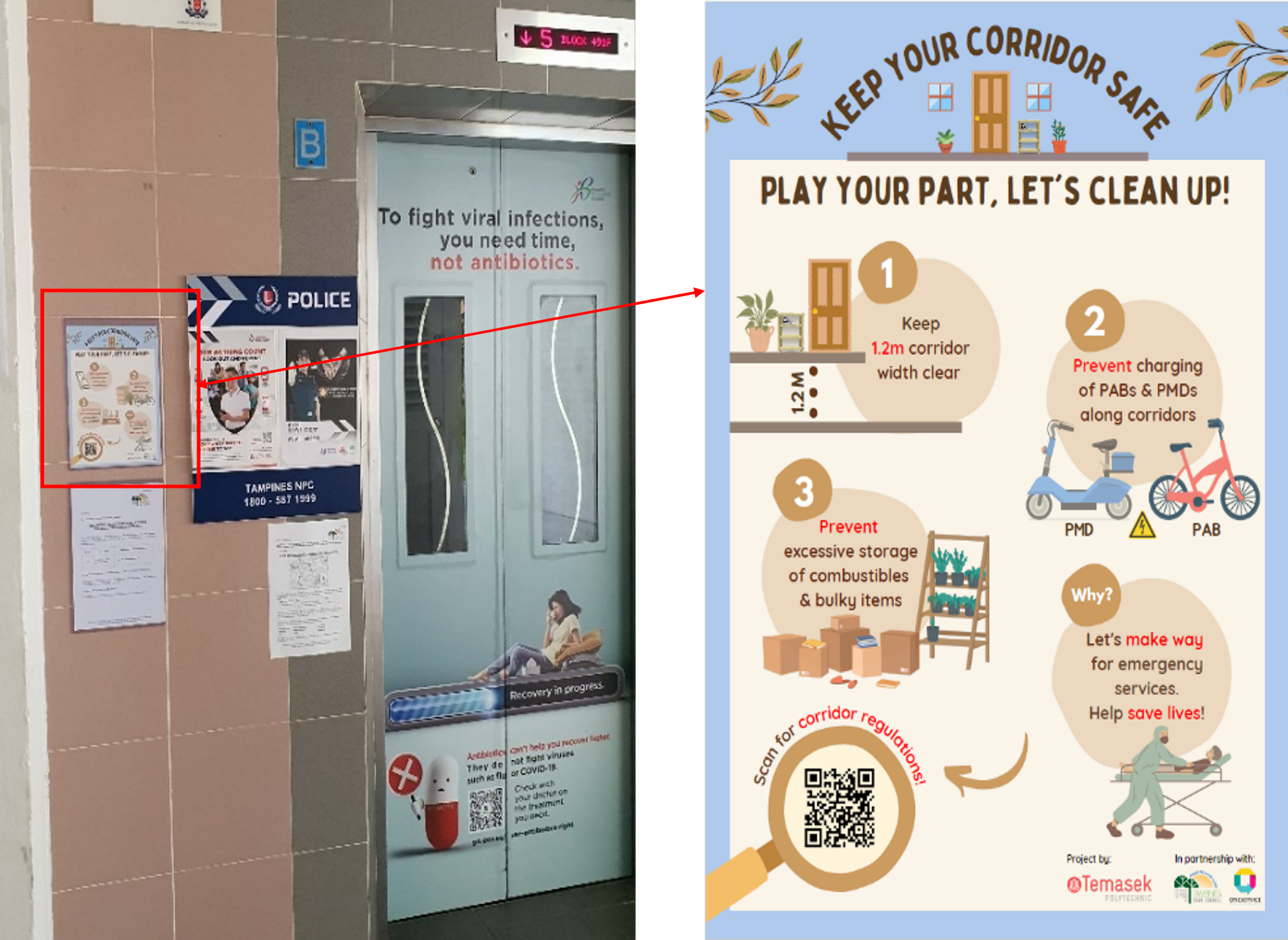
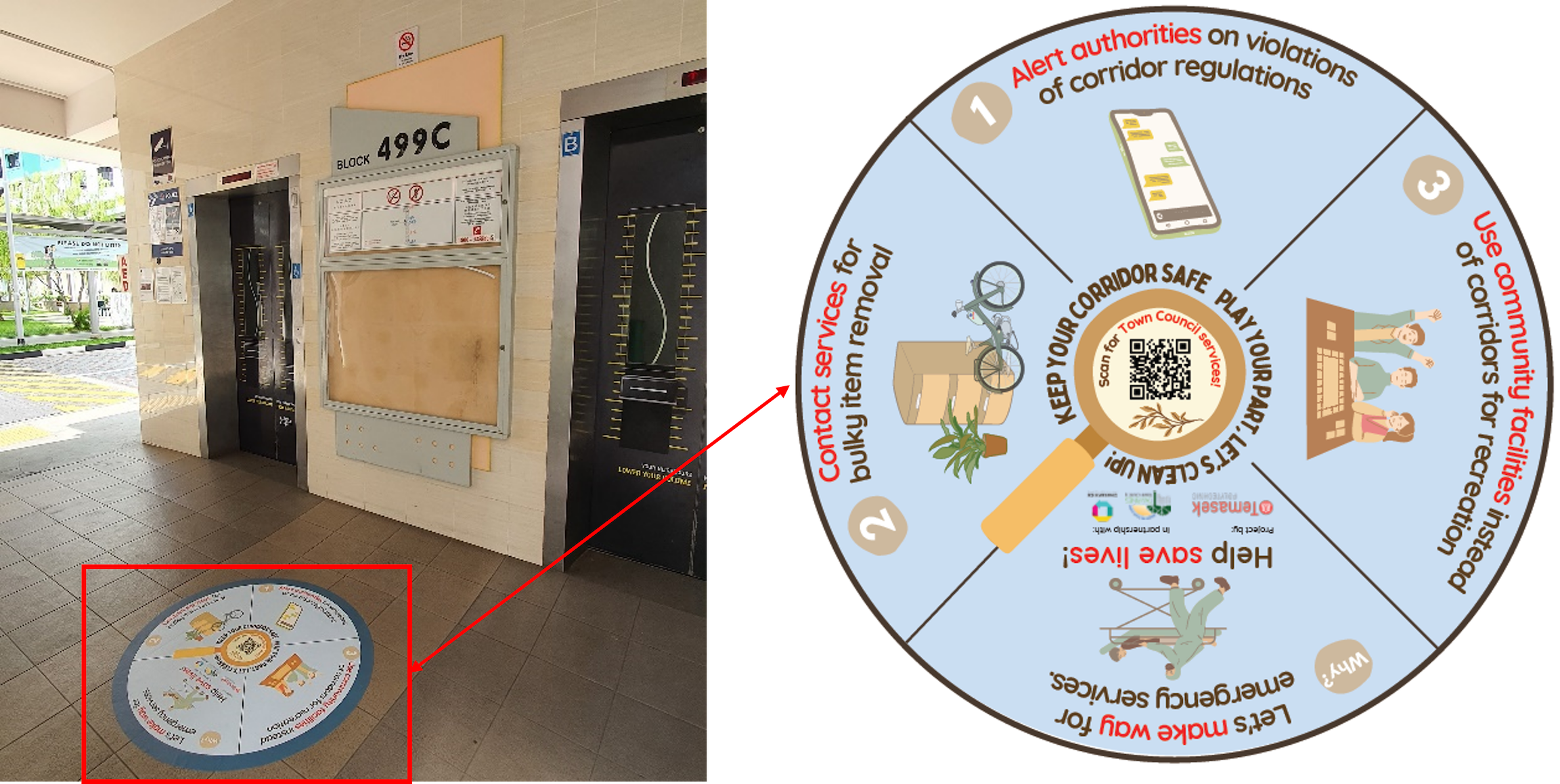
The project team put up wall posters and floor stickers at the ground-floor lift lobbies of the HDB blocks involved in the project in October 2022.
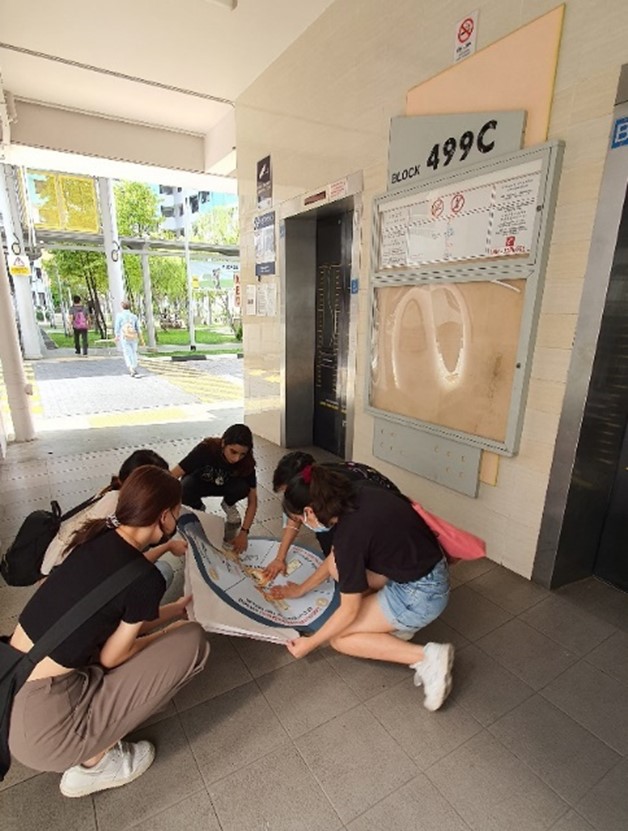
Students from TP’s School of Humanities & Social Sciences installing floor stickers at the selected HDB flats in Tampines East.
🔍 What we learnt
Face-to-face interviews with residents were critical in gaining a comprehensive understanding of the persistent issues of corridor cluttering, such as why residents clutter the corridor, and what would help to address the issue. For example, some residents were not aware of Town Councils’ free bulky item removal services, and therefore left items outside their flats.
Behavioural science principles were applied to help identify corridor cluttering behaviours and appeal to residents through positive messaging that encouraged clutter reduction, such as:
Using simple language that residents were familiar with.
Using colourful visuals and fonts to draw attention.
Using a simple step-by-step checklist to guide residents on appropriate behaviours.
Placing stickers and posters at strategic locations within residents’ line of sight, such as areas they frequently passed by or congregated at.
Working closely with the Town Council greatly facilitated the implementation of the solutions. In this case, TP sought the TTC’s assistance to identify suitable HDB blocks for implementation and to support the installation of materials in common spaces.
Conducting pre- and post-evaluation, such as resident surveys or on-ground observations using photographs, was important to measure project effectiveness and identify areas for improvement in future implementations.
⚙️ Key considerations
Materials used in outdoor settings, such as floor stickers, needed to be highly durable to withstand wet conditions due to heavy rain, and wear and tear from frequent foot traffic.
The solutions are likely to yield better results if implemented on a larger scale, such as across an entire precinct or town, and sustained over a longer period (e.g. 3 months or more) to increase awareness and behavioural adoption.
📈 Impact
Based on the students’ on-ground measurements conducted before and after project implementation, an estimated 30% reduction in corridor clutter was observed across 291 units at 5 selected HDB blocks in Tampines East.
Residents provided feedback that they were more aware of safety regulations and available services to keep common corridors clutter-free.
Most residents were receptive and open to discussions about relocating or removing items to ensure community safety and well-being.