
Noise Management - Neighbour Noise
Applying Behavioural Insights (BI) to nudge sports court users toward considerate noise-related behaviour in the community
31 July 2024
A Temasek Polytechnic-led project in Bishan East–Sin Ming used behavioural science interventions, such as clear rules and time-management devices, to reduce late-night noise by encouraging basketball court users to leave before closing, achieving over 50–60% improvement in compliance.
📌 About the project
Bishan East-Sin Ming Ward, Bishan-Toa Payoh GRC (2024).
Led by Temasek Polytechnic’s (TP) School of Humanities & Social Sciences, in partnership with Bishan-Toa Payoh Town Council (BTPTC) and supported by the MSO’s Project Code R.E.D. (Research, Engage, Deploy) initiative for Institutes of Higher Learning (IHLs).
Developed educational posters with an LED device to nudge basketball court users to practise consideration and leave by the courts’ closing times to minimise congregational noise.
🏘️ The issue
Basketball court users frequently stayed past the courts’ closing hours, causing late-night noise disturbances for residents in nearby HDB flats.
💡 What we did
The project team conducted interviews with users of the basketball courts as well as on-ground observations, in July 2024.
Behaviourial insights (BI) principles were applied to design and implement different BI interventions over a one-month period, featuring varied messages and reminders to encourage basketball court users to leave before the courts’ closing times. These interventions included:
Posters highlighting court usage rules, evoking empathy for nearby residents, and using positive messaging, such as “As a good basketball player, use the court responsibly”.
A time-management device with green, yellow, and red lights, as well as a digital countdown clock, to display remaining time and provide immediate feedback to users.
The interventions were placed at eye-level near benches where users typically gathered.
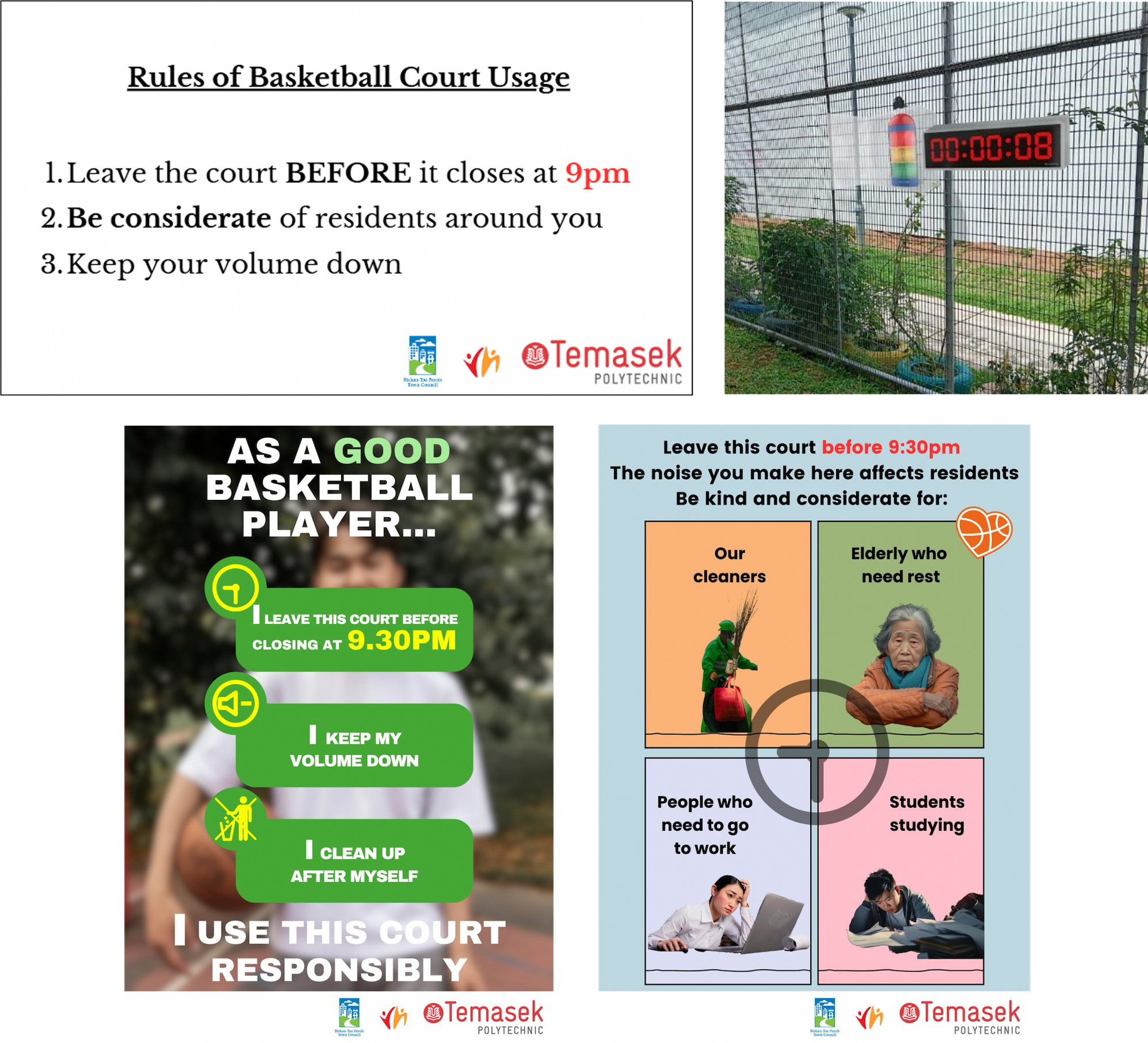
The BI posters with solutions implemented by the project team.
🔍 What we learnt
Clear rules, reminders, and environmental feedback (e.g. clocks and time-management devices) were more effective in encouraging users to leave before the courts’ closing times. Familiar cues, such as a traffic light colour system on the time-management device, provided intuitive signals that supported behaviour change.
Interventions relying on empathy and pro-social norms were less effective in influencing behaviour.
Behavioural science principles helped surface that informational nudges (i.e. clear rules and reminders) and environmental feedback were significantly more effective than moral nudges for this user group.
⚙️ Key considerations
Intervention materials needed to be securely placed and remain visible throughout the project period.
Behavioural nudges were more effective when information was clear and straightforward, minimising cognitive load for users.
📈 Impact
Based on the team’s findings, there was a significant increase in the proportion of users leaving before the courts’ closing times for two of its BI solutions: (1) about 60% for the rules and reminder poster, and (2) over 50% for the time-management device.
The project developed a framework and a set of possible BI solutions for potential rollout to other neighbourhood basketball courts across Singapore.